The Real Problem Isn’t a Lack of AI Strategy
Almost every technology company now has some relationship with AI: a few people quietly using ChatGPT to draft proposals, an engineer experimenting with a coding copilot, a product manager sketching a feature that bolts a model onto the roadmap. What's missing is rarely enthusiasm or tooling. What's missing is sequence: a shared, ordered view of where AI effort should go first, second, and third, so the organisation isn't running three uncoordinated AI experiments that quietly compete for the same attention and budget.
This is the gap the three-pillar framework is built to close. It doesn't tell you which specific model or vendor to use; that changes every quarter and isn't the strategic question. It tells you where to focus organisational energy, in what order, and what has to be true before you move from one pillar to the next. Leadership teams that skip this sequencing step tend to end up with impressive individual AI use and almost no organisational capability to show for it a year later.
Pillar One: Educate and Empower the Workforce
The first pillar is about people, not tools. Before AI can be operationalised or productised responsibly, the people closest to the work need enough working knowledge to use it well: what it's good at, where it fails, what not to paste into it, and how to sanity-check its output. Most companies get this backwards: they roll out tools before they've built any baseline capability, then act surprised when adoption is shallow, inconsistent, or risky.
Done properly, this pillar produces a workforce that treats AI the way a competent professional treats any powerful instrument, with fluency and appropriate scepticism, not blind trust or blanket avoidance. It's the foundation the other two pillars sit on: you cannot operationalise AI into workflows staffed by people who don't understand it, and you cannot productise AI credibly if your own team can't articulate what it does and doesn't do well.
Pillar Two: Operationalise AI
The second pillar is about embedding AI into how the business actually runs (support, sales, operations, engineering, finance) in a way that's durable and governed, not a collection of personal hacks that live in one person's browser history. Operationalising means AI is written into workflows, has a named owner, has a defined quality bar, and survives the person who introduced it leaving the company.
This is where most of the near-term efficiency gains genuinely live, and it's also where things quietly go wrong if pillar one was skipped. A support team that starts auto-drafting customer replies with AI, without review standards or escalation paths, is operationalising risk as fast as it's operationalising efficiency. Pillar two is deliberately positioned after pillar one and before pillar three: operational use cases are usually lower-risk and faster to prove out than customer-facing product bets, and they build the internal muscle the business needs before it starts shipping AI to customers.
Pillar Three: Productise AI
The third pillar is about where, if anywhere, AI belongs in what you sell: as a feature, a packaging lever, a pricing input, or a genuine product differentiator. This is the highest-stakes pillar because it's customer-facing and often irreversible in terms of expectations set: once customers expect an AI feature to work a certain way, walking it back is a trust problem, not just a product change.
Companies that jump straight to this pillar (often because a competitor announced an AI feature, or a board member asked 'what's our AI story') tend to ship shallow, bolted-on functionality that doesn't hold up under real usage, because the organisational muscle from pillars one and two isn't there yet to support it. The strongest AI product bets are usually made by teams who've already built internal fluency and operational discipline, because they know from firsthand use where AI is genuinely reliable enough to put in front of a paying customer.
The Governance Rail Underneath All Three
The pillars set the order. They don't, on their own, stop a business from moving faster than it can safely manage. That's the job of the governance rail: a small set of things that run underneath all three pillars from day one and grow as the business leans harder on AI. A named senior owner. A short acceptable use policy. An AI register listing every tool, feature and workflow, who owns it and how risky it is. A clear rule for when a human has to review AI output before it matters.
None of this is heavy. For a 20-person company it's a few short documents and a spreadsheet. But it's the difference between "we use AI a lot" and "we can show a customer, an investor or a regulator how we use AI", and buyers are asking. A-LIGN's 2026 Compliance Benchmark Report found four out of five organisations now field direct customer questions about their AI risk management.
Three Gates, Not Three Phases
The framework uses gates between the pillars rather than rigid phases. A gate is the minimum governance that should be true before the business leans harder on the next pillar. Teams can and should experiment ahead of a gate. What they shouldn't do is scale ahead of it.
| Gate | Before the business… | These should be true |
|---|---|---|
| Gate to Pillar Two | writes AI into workflows | A named senior owner for AI; an acceptable use policy everyone has acknowledged; an approved tools list and data rule; a sweep for unapproved AI use |
| Gate to Pillar Three | puts AI into what customers buy | Every AI workflow in the AI register with an owner and risk tier; AI vendors reviewed for training and retention terms; a check for automated decisions about individuals; the incident path tested at least once |
| Gate to Launch | ships an AI feature to paying customers | Impacts assessed, including how people can raise concerns; tested before release and monitored after; disclosure and privacy policy updated; an AI questionnaire answer ready; a working human override |
The middle gate now has a hard date attached for Australian businesses covered by the Privacy Act. From 10 December 2026, privacy policies must describe the kinds of decisions a computer program makes, or substantially and directly assists, where those decisions could significantly affect someone and use their personal information. The OAIC guidance is clear that human review doesn't take a decision out of scope. If Pillar Two has quietly put AI into how you screen applicants, prioritise customers, approve refunds or assess staff, that belongs in the register and potentially in the privacy policy. We explain the change in our 10 December explainer.
Using the Framework as a Diagnostic, Not Just a Model
The three pillars aren't meant to run in rigid sequence forever. Mature AI organisations eventually work all three in parallel. But for most technology companies today, there is a real and diagnosable gap: usually strong on ad hoc individual use, weak on pillar one's structured enablement, thinner still on pillar two's operational discipline, and prematurely exposed on pillar three because a product commitment got made before the foundation existed. The governance rail is usually thinnest of all, because nobody owns it.
Use the 3-Pillar AI Strategy Canvas to map your organisation's honest current state against each pillar and the rail, check each gate, and set one clear focus for the next 90 days. The goal isn't to declare a winner among the three. It's to see which pillar or gate is furthest behind relative to where the business is putting its AI energy, and correct the sequence before it costs you a customer-facing mistake. When you're ready to put the rail in place, the AI Governance Starter Pack has the policies and the register.
- Most technology companies don't lack AI strategy. They lack sequencing: a shared, ordered view of where AI effort should go first, second, and third.
- Pillar One (Educate and Empower the Workforce) is the foundation: people need working fluency before AI can be safely operationalised or productised.
- Pillar Two (Operationalise AI) embeds AI into workflows with named owners and quality bars. This is where most near-term efficiency gains live.
- Pillar Three (Productise AI) is the highest-stakes pillar because it's customer-facing and sets expectations that are hard to walk back.
- A governance rail (owner, policy, AI register, human review) runs underneath all three, and a gate between each pillar sets the minimum to have in place before scaling further.
- From 10 December 2026, Australian businesses covered by the Privacy Act must disclose certain automated decisions, so the Gate to Pillar Three includes checking for them.
Frequently asked questions
What is the Rev-IQ 3-Pillar AI Strategy Framework?
A sequencing model for AI adoption: Pillar One (Educate and Empower the Workforce), Pillar Two (Operationalise AI), Pillar Three (Productise AI), with a governance rail underneath and a gate between each pillar. Most technology companies don't lack an AI strategy; they lack this order.
Why does workforce education come before operationalising AI?
People need working fluency with AI before it can be safely embedded into workflows. Skip this step and Pillar Two gets built on a team that doesn't actually understand what it's using.
What is the governance rail?
The minimum governance that runs underneath all three pillars: a named senior owner, an acceptable use policy, an AI register and a rule for human review. It grows as the business leans harder on AI.
What are the gates?
A gate is the minimum that should be true before the business scales into the next pillar: Gate to Pillar Two, Gate to Pillar Three and Gate to Launch. Teams can experiment ahead of a gate but shouldn't scale ahead of it.
What’s the most common AI strategy mistake technology companies make?
Jumping straight to Pillar Three (productising AI for customers) under competitive pressure, before the organisational muscle from Pillars One and Two, and the governance rail, exist to support it.
Does the framework make a business compliant with AI regulation?
No. It is a sequencing and planning tool. The canvas shows where each gate lines up with Australia's Guidance for AI Adoption, ISO/IEC 42001 and the NIST AI RMF, but using it does not make a business compliant or certified.
3-Pillar AI Strategy Canvas
For leadership teams who need to map current AI maturity across all three pillars and decide where to focus effort next quarter.
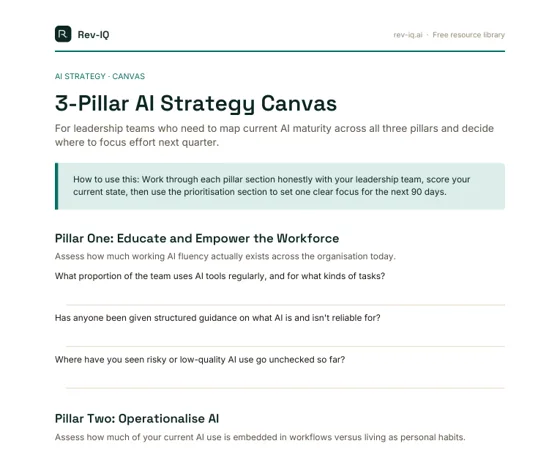
- Pillar One: Educate and Empower the Workforce
- Gate to Pillar Two
- Pillar Two: Operationalise AI
- Gate to Pillar Three
- Pillar Three: Productise AI
- Gate to Launch
- Maturity Scoring (including the governance rail)
- Next 90 Days: One Clear Focus
- Where This Maps
- Format
- PDF, 3 pages, designed to print and fill in
- Best for
- Leadership teams sequencing AI effort across their technology business
- What to bring
- Honest view of current AI use, workflows, governance and any AI product commitments
- After you submit
- Your download starts straight away. Nothing is emailed to you, and you won't be added to a mailing list unless you tick the opt-in.
Rev-IQ AI Readiness Check
A free AI skill for Claude, ChatGPT and Perplexity that checks whether your AI effort is going in the right order across the three pillars, and names the readiness gap to close first. It runs in your own AI account.
Get the free skill →Templates get you moving fast. If you want a structured read on where this is actually breaking down in your business, that's a short diagnostic conversation, not another download.
Discuss advisory support →