Governance Isn’t Bureaucracy, It’s an Answer to a Simple Question
Ask almost any technology company leadership team a simple question: if an AI tool produced a wrong, biased, or harmful output tomorrow (in a customer email, a piece of code, a hiring decision, a financial figure), who would find out first, who would decide what to do, and how fast would it get fixed? In most companies, there's an uncomfortable pause, because the honest answer is 'whoever happens to notice, if they notice.' That pause is the governance gap, and it exists in nearly every technology company that has adopted AI faster than it has governed it, which, at this point, is nearly every technology company.
Governance is not about slowing AI adoption down with process for its own sake. It's about making sure that when something goes wrong (and at some point, something will) there's a clear owner, a clear process, and a clear escalation path, rather than a scramble to figure out who's responsible after the fact. Companies with real governance in place aren't the ones using AI the least; they're often using it the most, because clear ownership makes people more confident to use AI, not less.
Why This Gap Is Especially Costly for Technology Companies
Technology companies are often further ahead on AI usage than the average business, which means the governance gap is proportionally larger, not smaller. Engineering teams are shipping AI-generated code, support teams are drafting AI-assisted customer communications, and product teams are considering AI features, often with more real usage than actual oversight. The absence of governance doesn't show up as a dramatic failure most of the time; it shows up as small, quiet risks accumulating: unreviewed code with subtle security issues, customer communications that drift in tone or accuracy, AI tools approved by individual engineers without any data handling review.
The cost of this gap tends to surface at the worst possible moment: during due diligence for a fundraise or acquisition, when a customer contract requires evidence of AI governance, or after an actual incident that could have been caught earlier with a basic review step. Building governance proactively is dramatically cheaper than building it reactively under pressure.
Seven Policies, Not One Giant Document
Effective AI governance for a small or mid-size technology company isn't one sprawling policy nobody reads. It's a small set of short, specific documents that each answer one real question: what's acceptable use, how is data handled, who reviews AI output before it matters, how are new AI tools approved, what's the verification standard, what do we tell customers, and what's the escalation path when something goes wrong. Each one is short enough to actually be read and followed, which is the entire point.
This is deliberately different from adopting a generic enterprise AI governance framework built for a much larger, more regulated organisation. A ten-person technology company doesn't need a compliance department's worth of process. It needs seven clear, adoptable documents that assign real ownership and give the team an actual answer when the uncomfortable question comes up.
Starting Point, Not Finish Line
The starter pack is meant to be adopted close to as-is and then adjusted as the company's actual AI use evolves: a company shipping its first customer-facing AI feature will need to revisit the transparency and verification documents specifically; a company scaling its engineering team will need to revisit tool approval. Governance that's never revisited becomes theatre; governance that's revisited as usage changes stays genuinely useful.
Use the AI Governance Starter Pack to put basic ownership, review, and escalation structure around AI use in your company this week, not eventually, starting with whichever document addresses your most immediate exposure, and rolling out the rest over the following month.
- The core governance question is simple: if AI produces a wrong or harmful output, who finds out, who decides what to do, and how fast does it get fixed?
- Technology companies often have a larger governance gap than average because AI usage is already ahead of oversight across engineering, support, and product.
- The cost of missing governance tends to surface at the worst time: due diligence, customer contract review, or after an actual incident.
- Effective governance for a small technology company is seven short, specific policy documents, not one sprawling enterprise framework.
- The starter pack is a starting point that should be revisited as AI use evolves, especially around new customer-facing features or tool adoption.
AI Governance Starter Pack
Seven adoptable policy documents that give a small technology company real ownership, review, and escalation structure around AI use. Includes 7 ready-to-use policy documents as a single ZIP download.
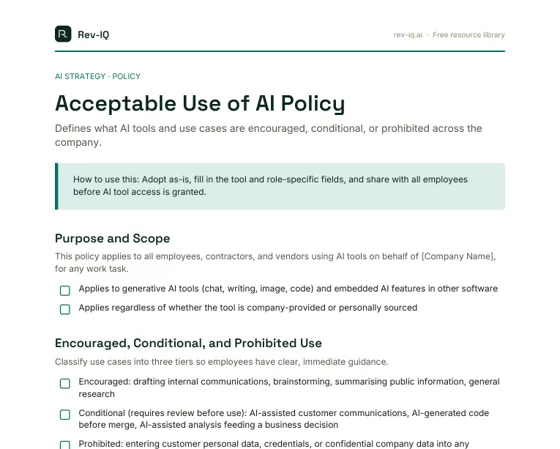
- Acceptable Use of AI Policy
- AI Data Handling Policy
- Human Review and Accountability Policy
- AI Procurement and Tool Approval Policy
- AI Output Verification Standard
- AI Transparency / Disclosure Guidance
- AI Risk and Escalation Framework
- Format
- ZIP file of 7 PDF policies, 8 pages in total, ready to adapt
- Best for
- Leaders at small technology companies already using AI
- What to bring
- Current AI tools and uses, data types involved, and who owns decisions
- After you submit
- Your download starts straight away. Nothing is emailed to you, and you won't be added to a mailing list unless you tick the opt-in.
Templates get you moving fast. If you want a structured read on where this is actually breaking down in your business, that's a short diagnostic conversation, not another download.
Discuss advisory support →