The Real Failure Mode Isn't the Incident. It's the First Hour
When something goes wrong (a suspicious login, a data exposure, an outage that looks like an attack, a vendor breach that might affect your customers), the technical problem is rarely what causes the most damage. The damage comes from a chaotic first hour: nobody knows who's in charge, three people message each other in parallel, someone tells a customer something that turns out to be wrong, and thirty minutes are lost working out who should be making decisions.
Most small technology teams have never rehearsed this moment, so the first real incident becomes a live test of a process that doesn't exist. A mediocre plan followed calmly beats a perfect plan that lives only in someone's head.
The First Four Moves, In Order
First, contain. Stop the immediate bleeding (revoke a compromised credential, take a system offline, disable an exposed integration or AI agent) before worrying about root cause. Second, assess. Get an honest picture of what's known versus assumed: which data and systems are affected, whether personal information is involved, how many people, and how confident that assessment is. Third, communicate. Decide who needs to know, internally first, then customers if they're affected, then any regulator, and say only what's confirmed.
Fourth, stabilise and document. Restore normal operation and keep a running log of what happened, when, and what was done. That record is what makes the post-incident review useful, and it's what a customer, insurer or regulator will ask to see.
Know Your Notification Clocks Before You Need Them
The most expensive mistake in a privacy incident is discovering the regulatory deadlines halfway through it. The clock usually starts when you first have reason to suspect a breach, not when you finish investigating, so write down that moment. These are the ones Australian, New Zealand and UK technology businesses most often meet:
| Obligation | Trigger | Timeframe |
|---|---|---|
| Australia: Notifiable Data Breaches scheme | An eligible data breach likely to cause serious harm | Take all reasonable steps to assess within 30 days of suspecting; notify the OAIC and affected individuals as soon as practicable |
| Australia: ransomware payment report | A ransomware or cyber extortion payment by or for a business at or above the A$3 million turnover threshold | Within 72 hours of the payment, or of becoming aware of it |
| New Zealand: Privacy Act 2020 | A notifiable privacy breach likely to cause serious harm | As soon as practicable; the Privacy Commissioner expects notice within 72 hours |
| United Kingdom: UK GDPR | A personal data breach likely to result in a risk to individuals | Without undue delay and, where feasible, within 72 hours of becoming aware |
| Customer contracts | As defined in each agreement | Often shorter than the regulator. Know your shortest commitment |
Name one person who owns the notification decision, and have them record the decision either way. Even when a breach turns out not to be notifiable, a documented assessment is the evidence that you took it seriously.
AI Incidents Use the Same Four Moves
AI adds new kinds of incident, and it helps to name them in advance so nobody hesitates to raise one: a wrong or harmful AI output that reached a customer, customer data pasted into an unapproved AI tool or personal account, an AI agent that sent, deleted or changed something nobody intended, prompt injection that caused an AI feature to leak data or ignore its instructions, and an automated decision about a person that's challenged as unfair. The sequence doesn't change. Contain (switch the feature or agent off), assess (including whether personal information was exposed), communicate, then stabilise and document, keeping the prompts and outputs as evidence.
Scale the Response, and Make Sure People Know the Plan Exists
The response should scale to severity. A minor, contained issue might take fifteen minutes and a chat thread. A serious exposure of personal information needs a senior leader immediately, clear customer communication, legal input and a decision on every notification clock. A simple severity framework, agreed in advance, prevents both underreacting and overreacting.
A plan only works if people know where it is. Use the Incident Response Playbook Template to define severity levels, decision-makers, the notification owner and the first-response sequence now, while there's no pressure.
- The most damaging part of an incident is usually the chaotic first hour, not the technical problem.
- The first-response sequence is contain, assess, communicate, then stabilise and document, every time.
- Know the notification clocks in advance: a 30-day assessment window under Australia's NDB scheme, 72 hours for ransomware payment reports, and around 72 hours in New Zealand and the UK.
- AI incidents (wrong outputs, data in unapproved tools, runaway agents, prompt injection) use the same sequence and should be named in the plan.
- Name one notification owner and record every notification decision, including decisions not to notify.
Incident Response Playbook Template
For founders and operations leaders who need a clear, ready-to-use first-response sequence for security and operational incidents.
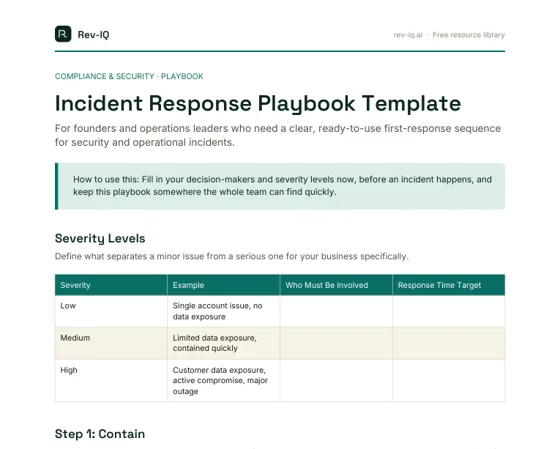
- Severity Levels
- Contain
- Assess
- Notification Clocks
- Communicate
- AI Incidents
- Stabilise and Document
- Post-Incident Review and Standards Map
- Format
- PDF, 3 pages, designed to print and fill in
- Best for
- Founders and operations leaders at small technology teams
- What to bring
- Names of decision-makers, your systems and data types, the countries your customers are in, and your contractual notification commitments
- After you submit
- Your download starts straight away. Nothing is emailed to you, and you won't be added to a mailing list unless you tick the opt-in.
Templates get you moving fast. If you want a structured read on where this is actually breaking down in your business, that's a short diagnostic conversation, not another download.
Discuss advisory support →