The Tool You Signed Up for in Five Minutes Is Now Part of Your Risk Profile
Modern technology businesses run on a stack of third-party tools (analytics, payments, support, email, AI, infrastructure), and most were adopted the way small teams adopt everything: someone needed to solve a problem, signed up with a company card, and connected it to real data within the hour. That speed is an advantage. It's also how a company ends up with dozens of vendors touching customer data that nobody assessed.
Every vendor with access to customer data, source code or company systems is functionally an extension of your own security posture. If that vendor has a breach, an outage or shuts down, the consequences land on your business and your customers.
What Actually Needs Reviewing, and What Doesn't
Treating every vendor identically is how review programs collapse under their own process. A project management tool with no customer data and a payments processor handling card details aren't the same risk. Tier vendors by what they touch: critical vendors (customer data, payments, core infrastructure, code) get a real review; low-risk tools get a light check and move on.
For the vendors that matter, the review needs to answer a short list of consistent questions: what data can they access, where is it stored, what's their security posture, how fast will they tell you about an incident, and what's the exit plan. Most of it is answerable from a vendor's security page, their questionnaire responses or a short conversation.
AI Vendors Need Five More Questions
AI has changed vendor risk in two ways. New AI vendors arrive constantly, and existing vendors switch on AI features in product updates, often by default. Either way, add these questions for any vendor whose product includes AI:
- Training: is our data, including prompts, files and outputs, used to train or improve any model, and does the contract say so?
- Retention and location: how long are prompts, outputs and logs kept, and in which country?
- Model providers: which models sit behind the product, and will we be told before that changes?
- Control: can we switch AI features off, or limit them to certain data?
- Decisions about people: does the product make or substantially inform decisions about individuals?
That last one carries a deadline. From 10 December 2026, Australian businesses covered by the Privacy Act must describe certain automated decisions in their privacy policies, and the OAIC's guidance says the obligation generally stays with the business that arranged for the software to be used, even when a vendor runs it. It also says businesses should understand how third-party programs make or assist decisions, during and after procurement, and that contracts should be clear about who keeps decision-making control. Read more in our explainer on the 10 December change.
Put It in the Contract
For critical and AI vendors, the useful protections are contractual, not just in the FAQ: no training on your data without written consent, defined retention and deletion for prompts and outputs, an incident notice period short enough to meet your own regulatory clocks, advance notice of new subprocessors or model providers, enough information about automated decision features to meet your disclosure obligations, and access to security evidence on request. Your lawyer will adapt the wording; the checklist gives you the list to raise.
The Underrated Risk: Operational Dependency
Security is the obvious vendor risk, but operational dependency is more common. A vendor that raises prices sharply, changes its API, gets acquired and sunsets the product, or goes down during a critical period can disrupt a small company as badly as a security incident. A useful review asks not just "is this safe" but "what happens to us if this vendor changes tomorrow". Use the Vendor Risk Review Checklist to tier your vendors, review the ones that matter, and build the habit of checking new tools, and new AI features, before they reach real data.
- Every third-party tool connected to customer data or company systems inherits part of your risk profile.
- Tier vendors by what they touch; critical vendors warrant real review and low-risk tools need only a light check.
- AI vendors, and vendors that add AI features, need extra questions on training, retention, model providers, controls and decisions about people.
- From 10 December 2026, the privacy policy disclosure for automated decisions generally stays with you, even when a vendor's software makes the decision.
- The protections that matter belong in the contract: no training, retention limits, incident notice, subprocessor notice and decision transparency.
Vendor Risk Review Checklist
For operations and technical leaders who need a fast, consistent way to assess third-party tools before and after they're connected to company data.
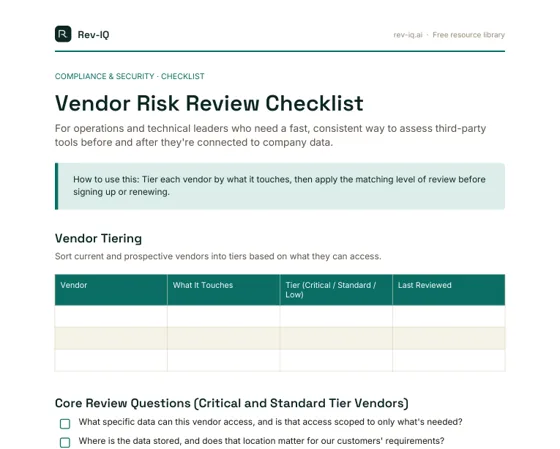
- Vendor Tiering
- Core Review Questions
- AI Vendor Questions
- Contract Clauses to Ask For
- Operational Dependency Check
- Low-Tier Vendor Fast Check
- New Vendor Intake Habit and Standards Map
- Format
- PDF, 3 pages, designed to print and fill in
- Best for
- Operations and technical leaders reviewing third-party tools
- What to bring
- A list of current vendors, what data or systems each can access, and which have AI features
- After you submit
- Your download starts straight away. Nothing is emailed to you, and you won't be added to a mailing list unless you tick the opt-in.
Templates get you moving fast. If you want a structured read on where this is actually breaking down in your business, that's a short diagnostic conversation, not another download.
Discuss advisory support →