The Question Nobody Can Answer Confidently
Ask most small technology teams what their most sensitive data is and where it lives, and the answer is usually a shrug, a guess, or three different answers from three people. It isn't carelessness. Data accumulates faster than anyone decides how to treat it: a spreadsheet export here, a support ticket with payment details there, production credentials pasted into a chat thread for a quick fix. None of it feels risky in the moment. Together it's an unmanaged sprawl of exactly the data a breach would want most.
Classification sounds like a compliance exercise, but it's a business decision: not all data deserves the same handling. Marketing copy and customer payment details don't belong in the same bucket, yet in most small companies they get roughly the same level of care.
A Simple Classification System Beats an Elaborate One
The companies that get this right use two or three tiers (public, internal and restricted) with a clear rule for each. Restricted data (customer personal information, payment details, credentials, health or financial data) gets encryption, tight access and no casual copying into tools not built to hold it. Internal data gets normal access controls. Public data needs no special handling. The value isn't sophistication; it's everyone using the same categories to make the same decisions.
AI Has Created New Places for Data to Hide
Most data maps were drawn before AI tools arrived, and they miss the new stores AI creates: prompts and chat histories, files uploaded for summarising, outputs saved into documents and tickets, embeddings and vector databases built from company content, and the logs model providers keep. Each can hold restricted data. Few have an owner, a location on the map, or a retention period.
The fix is to treat them like any other system. Add each AI tool to the classification, decide which tiers it may hold, use company accounts on approved tools under agreements that exclude training on your data, and set retention for prompts, outputs and embeddings. Check where providers store and process data, too. Under Australia's Privacy Act, sending personal information offshore brings cross-border obligations under APP 8, and New Zealand's IPP 12 has a similar rule.
Storage, Sharing, and the Habit of Over-Collecting
Two behaviours create most of the risk in this domain. The first is storing sensitive data in tools that weren't built for it (spreadsheets, shared drives, chat tools, and now AI chats) because it was the fastest place to put it. The second is collecting more than the business needs because a form was easy to add a field to. Every extra field of sensitive data is something you now have to protect, retain properly and justify.
Retirement is the most commonly skipped step. Australia's APP 11.2 expects organisations to destroy or de-identify personal information they no longer need, and New Zealand's IPP 9 and the UK GDPR's storage limitation principle say much the same. Most small companies have no deletion habit at all, so sensitive data accumulates indefinitely in more places than anyone can track.
Making Classification Practical
A classification policy only works if it changes behaviour, so it has to be short enough to remember and specific enough to settle real situations: support tickets, sales exports, debugging, vendor tools and AI prompts. Use the Data Handling and Classification Policy Template to define your tiers, map where sensitive data lives today (including AI tools), and set clear rules for storage, sharing and retirement.
- Most small technology teams cannot say confidently what their most sensitive data is or where it lives. That ambiguity is the real risk.
- A simple two-to-three tier classification beats an elaborate taxonomy because everyone can apply it.
- AI tools create new data stores (prompts, uploads, outputs, embeddings, provider logs) that need owners, tiers and retention periods.
- Know where AI providers store and process personal information; offshore handling brings cross-border obligations.
- Deletion is the most skipped practice, and privacy law in Australia, New Zealand and the UK expects it.
Data Handling and Classification Policy Template
For founders and operations leaders who need a clear, adoptable standard for how data is stored, shared, accessed, and retired.
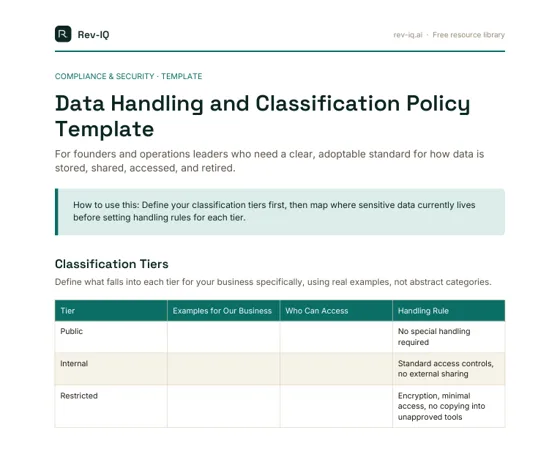
- Classification Tiers (including AI tools)
- Where Sensitive Data Actually Lives
- AI Data Stores
- Storage and Sharing Rules
- Retention and Retirement
- Adoption and Review
- Standards Map
- Format
- PDF, 3 pages, designed to print and fill in
- Best for
- Founders and operations leaders setting data handling standards
- What to bring
- A list of your systems, vendors and AI tools, and the data types each one holds
- After you submit
- Your download starts straight away. Nothing is emailed to you, and you won't be added to a mailing list unless you tick the opt-in.
Templates get you moving fast. If you want a structured read on where this is actually breaking down in your business, that's a short diagnostic conversation, not another download.
Discuss advisory support →