Access Sprawl Happens Quietly, One Invite at a Time
No one designs a bad access model on purpose. It happens through a hundred small, reasonable decisions: a contractor gets admin access because it was faster than scoping permissions, a former employee's login still works because nobody removed it, a departed co-founder still has access to the production database. Each decision made sense at the time. Together, they produce a system where nobody can say with confidence who can do what.
Access failures are rarely caught by normal business activity. A messy sales process shows up in the pipeline numbers. A messy access model shows up only when something goes wrong, or when a customer's security review asks a direct question the team can't answer.
Role-Based Access Is Simpler Than It Sounds
Role-based access at small scale is just a decision about which handful of roles exist (engineer, support, sales, finance, admin) and what each can see and touch, applied consistently. Most tools already support it; they're rarely configured deliberately.
The principle to adopt early is least privilege: give people the access their role needs, not broad access because it was convenient to set up once. It isn't about distrust. It limits the blast radius when an account is compromised, a mistake is made, or someone leaves on bad terms. For admin accounts, keep them separate from everyday accounts and use phishing-resistant multi-factor authentication, such as passkeys or security keys, wherever your tools support it.
The Accounts Nobody Offboards: Machines and Agents
Most access policies were written for people. In a modern technology business, people are now outnumbered by service accounts, API keys, integration tokens, OAuth grants ("Sign in with Google" consents) and, increasingly, AI assistants and agents connected to email, drives, code and the CRM. Each one can reach real data. Many were set up by one person, have no owner, and never expire.
ASD's new Essentials for enterprise IT, published on 15 October 2026, makes the point explicitly: user, administrative and non-person accounts should all have only the minimum access they need, and credentials should be unique per system. In practice that means three habits: every non-human identity has a named human owner, no key is shared between systems, and AI tools connected to company data are approved and scoped like any other account.
Offboarding Is Where Access Control Gets Tested
Granting access thoughtfully matters, but removing it promptly is where most companies fail. Offboarding is easy to deprioritise: there's a notice period, everyone's focused on the handover, and access removal slips to "sometime this week". That gap is exactly when risk is highest.
A reliable process treats access removal as a same-day step tied to the last working day. It covers every system that matters: email, code repositories, cloud infrastructure, customer data platforms, financial systems and shared credentials. It now also covers the tokens, OAuth grants and AI agents the person set up, which keep working after their login is gone unless someone revokes or reassigns them.
Turning This Into a Living Policy
A one-time access audit decays within a quarter unless it's backed by a policy that says who approves new access, how often access is reviewed, and what happens on someone's last day. Use the Access Control and Offboarding Policy Template to define roles, map current access for people and machines, and put a same-day offboarding checklist in place. Most teams are surprised by how much access exists that nobody remembers granting.
- Access sprawl accumulates through small, reasonable decisions and stays invisible until something goes wrong.
- Role-based access at small scale means deciding which roles exist and what each can touch, then applying it consistently.
- Admin accounts should be separate from everyday accounts and use phishing-resistant MFA where supported.
- Service accounts, API keys, OAuth grants and AI agents need named owners and least-privilege access, just like people.
- Same-day offboarding must now include the tokens, app grants and AI connections a person set up, not just their login.
Access Control and Offboarding Policy Template
For founders and operations leaders who need a clear, adoptable policy for granting, reviewing, and removing system access.
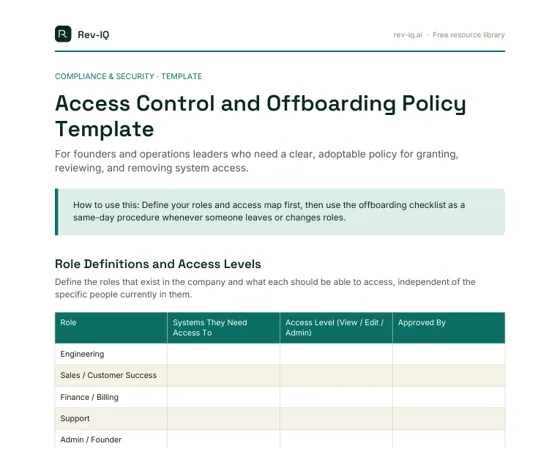
- Role Definitions and Access Levels
- Current Access Map
- Non-Human Identities
- Access Request and Approval Process
- Quarterly Access Review
- Same-Day Offboarding Checklist
- Standards Map
- Format
- PDF, 3 pages, designed to print and fill in
- Best for
- Founders and operations leaders at small technology companies
- What to bring
- List of your systems, current users and their access, service accounts and API keys, connected AI tools, and team roles
- After you submit
- Your download starts straight away. Nothing is emailed to you, and you won't be added to a mailing list unless you tick the opt-in.
Templates get you moving fast. If you want a structured read on where this is actually breaking down in your business, that's a short diagnostic conversation, not another download.
Discuss advisory support →