The Questionnaire Isn't the Obstacle: Unpreparedness Is
Somewhere between first traction with mid-market or enterprise customers and real scale, almost every technology company gets its first real security questionnaire. It's usually a spreadsheet with 40 to 150 questions, sent by someone in IT or procurement the sales team has never spoken to, and it lands just as a deal felt close to done. Teams that haven't prepared treat it as a fire drill, pull engineers off roadmap work, guess at answers, and burn a week or two while the champion on the customer side goes quiet.
The questionnaire rarely asks anything unreasonable. It covers access control, encryption, backups, subprocessors, incident response and hosting: the same themes, phrased differently, deal after deal. The teams that handle this well aren't necessarily more secure. They've answered the questions once, written the answers down, and now reuse and adapt them.
The New Section: AI
The biggest change in the last year is a new block of questions about AI. A-LIGN's 2026 Compliance Benchmark Report found that four out of five organisations now field direct customer questions about their AI risk management. Some buyers add a dedicated AI addendum; others fold the questions into the main review. Either way, they tend to ask the same things:
- Which AI features are in the product, and which model providers power them?
- Is our data, including prompts and outputs, used to train any model, and where does the contract say so?
- How long are prompts, outputs and logs kept, and where?
- Can we switch AI features off or limit what data they reach?
- What human oversight applies, and how are AI features tested and monitored?
- Does any feature make or substantially inform decisions about individuals?
That last question matters more from 10 December 2026. Australian businesses covered by the Privacy Act must describe certain automated decisions in their privacy policies from that date, and the OAIC guidance says they should understand how third-party software makes or assists decisions. If your product scores, ranks, flags or approves anything about your customers' customers or staff, expect them to ask you for the detail. We cover this in our December 10 explainer.
What Reviewers Are Actually Checking For
A reviewer on the buying side isn't looking for perfection. They want evidence that someone has thought about risk deliberately: access is controlled, data isn't floating around unmanaged, there's a plan if something goes wrong, and the vendor won't be the reason their own company ends up with an audit finding. Vague or contradictory answers are a bigger red flag than an honest "not yet, here's our plan".
It also helps to recognise the format. A SIG or CAIQ questionnaire signals a formal third-party risk program. Questions numbered against ISO/IEC 27001 Annex A mean the buyer will map your answers to its own controls. A SOC 2-style structure means a SOC 2 report could replace most of it. An AI addendum referencing ISO/IEC 42001 or the NIST AI Risk Management Framework means there's an AI governance function on the other side, and they'll want your AI policy and AI register.
Building a Reusable Answer Library
The highest-leverage move is a living answer library: the standard questions any serious buyer will ask, with current, accurate answers, updated as the business changes. It turns a two-week scramble into a same-day turnaround, and it means customers get the same answers legal and engineering would give, because they were written together in advance.
Keep it where the go-to-market team can reach it, not in one engineer's inbox, because the first person to see a questionnaire is usually in sales or customer success. Reviewers check for consistency, too: if the security answers say access is tightly controlled but a salesperson mentions an intern has production admin rights, that gap costs trust well beyond one question.
Treating Readiness as a Sales Asset
A team that treats questionnaires as a compliance tax will always be reactive. A team that treats readiness as a competitive asset invests in it early, shares a short security and AI overview before it's asked for, and wins time back on every deal. Use the Security Questionnaire Readiness Checklist to build the library now, including the AI section, and to find the gaps questionnaires are most likely to expose.
- Most security questionnaires repeat the same themes: access control, encryption, backups, subprocessors, incident response and hosting.
- AI is now a standard section. Expect questions on model providers, training on customer data, retention, opt-outs, oversight and testing.
- From 10 December 2026, Australian customers may ask for detail on automated decisions your product makes, so they can meet their own privacy policy obligations.
- A reusable, pre-approved answer library turns a multi-week scramble into a same-day response and keeps sales, legal and engineering aligned.
- Reviewers want deliberate, consistent risk management, not perfection. An honest gap with a plan beats a vague answer.
Security Questionnaire Readiness Checklist
For revenue and operations leaders who need to respond to customer security reviews quickly and consistently instead of scrambling deal by deal.
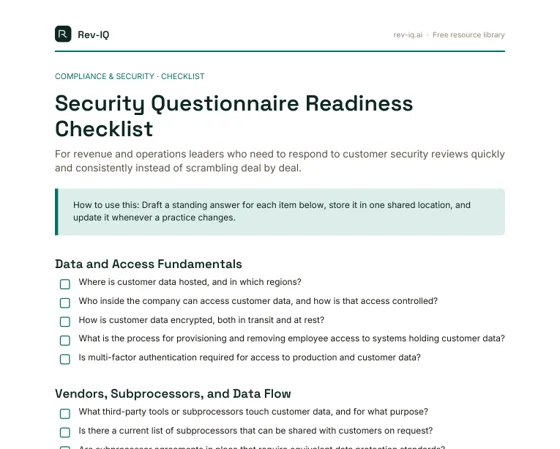
- Data and Access Fundamentals
- Vendors, Subprocessors, and Data Flow
- AI and Model Use
- Continuity, Backup, and Incident Response
- Certifications and Formal Frameworks
- Standards Buyers Map You Against
- Readiness Tracker
- Format
- PDF, 3 pages, designed to print and fill in
- Best for
- Revenue and operations leaders facing customer security reviews
- What to bring
- Current security practices, vendor and subprocessor list, AI features and model providers, backup and incident details, certifications held
- After you submit
- Your download starts straight away. Nothing is emailed to you, and you won't be added to a mailing list unless you tick the opt-in.
Templates get you moving fast. If you want a structured read on where this is actually breaking down in your business, that's a short diagnostic conversation, not another download.
Discuss advisory support →