Security Debt Is Just Technical Debt With a Deadline
Most small technology companies treat security the way they treat documentation: something to get to later, once there's time. The problem is that security debt doesn't sit quietly waiting to be paid down on your schedule. It surfaces on someone else's timeline: a customer's procurement team, an investor's diligence checklist, or a laptop stolen from a car. At that point the cost of not having a baseline is a stalled deal, an awkward board conversation, or a scramble to prove you were never careless.
A credible baseline is smaller than most founders assume. It isn't SOC 2, and it isn't a full-time security hire. It's a short list of controls around who can access what, how devices are managed, how AI tools are used, what's written down, and how incidents get handled. The aim is to be consistent, not comprehensive.
The Five Domains That Actually Matter Early
Trust is the first: does anyone outside the company know what you do to protect their data, or are they taking it on faith? Access is the second: can you say right now who has access to production, customer data and billing, and why? Devices are the third: are the laptops and phones that touch company systems encrypted, patched and recoverable?
AI and automation is the fourth, and it's new. Documentation and response is the fifth: if the founder or lead engineer were unavailable tomorrow, could someone else find the access list, the offboarding process and the incident plan?
None of these needs exotic tooling. Most can be handled with settings already available in the tools a small team uses: single sign-on, device management defaults, a shared drive with real structure. What's usually missing isn't capability. It's a decision and a record of it.
The Fifth Domain Nobody Planned For: AI and Automation
Two years ago this domain didn't need its own line. Now most teams use AI tools every day, and a growing number have connected assistants and agents to email, drives, code repositories and the CRM. In an Okta survey reported by The Register, 60% of Australian workers said they had used AI in ways their employer hadn't approved, and 58% of executives said their organisation had an AI-related security incident or near miss in the previous 12 months.
Buyers have noticed. A-LIGN's 2026 Compliance Benchmark Report found that four out of five organisations now field direct customer questions about how they manage AI risk. The minimum here is simple: an approved tools list, a rule for what data can go into which tool, company accounts rather than personal ones for anything sensitive, a list of what AI tools are connected to, and a written answer to the question "where do you use AI, and how do you check it?"
If Your Product Is AI-Built, Check the Defaults
Many younger technology businesses now write a large share of their code with AI assistants or app builders. That's a real speed advantage, and it changes where the risk sits. A June 2026 study of 200 publicly deployed vibe-coded applications found that 91% had at least one vulnerability, concentrated in broken access control, injection and authentication failures.
The fix isn't to stop using the tools. It's to put human review where the damage would be: authentication, authorisation, payments and data access. Keep secrets out of code and prompts, check dependencies the assistant suggests before adding them, and review the default settings an app builder ships with (open databases and public storage buckets are common) before anything goes live.
Why This Becomes Commercially Urgent Faster Than Expected
Security posture stops being optional the moment a technology company sells into organisations bigger than itself, which for most B2B businesses happens earlier than founders expect. A 20-person company selling to a 500-person customer will meet a security questionnaire, an IT review, or a pointed email from procurement asking how customer data is protected, and now how AI is used with it.
The commercial cost of weak posture is rarely a breach. It's friction: slower deals, lower trust, and opportunities that quietly go to a competitor who could answer the same questions in five minutes instead of five weeks.
Building the Baseline Without Overbuilding It
The instinct once a founder starts caring about security is to overcorrect: buy tools, hire a fractional CISO, chase a certification that isn't yet commercially necessary. The better sequence is to fix the five domains at a baseline level, write down what's been done, and escalate to a formal framework only when a specific buyer or market asks for it. These are the usual triggers:
| Trigger | What it usually points to |
|---|---|
| US enterprise buyers ask for an attestation report | SOC 2 Type I, then Type II |
| Enterprise, government or tender buyers in Australia, New Zealand, the UK or Europe ask for certification | ISO/IEC 27001 |
| Buyers ask how you manage AI risk, or AI is central to what you sell | ISO/IEC 42001, the AI management system standard, often alongside 27001 |
| You sell to Australian government or critical-infrastructure customers | ASD's frameworks, which as of 15 October 2026 means ASD Essentials for enterprise IT |
| None of the above yet | Keep the baseline current and offer a short security overview instead |
One change worth knowing about: on 15 October 2026 the Australian Signals Directorate evolved the Essential Eight into ASD Essentials for enterprise IT, organised around eight domains including identity, governance and culture (which now explicitly covers AI accountability), and visibility and response. If a customer or regulator still requires Essential Eight reporting, keep meeting it. Otherwise the new framework is the reference point.
Use the Minimum Viable Security Posture Checklist to see where your baseline stands across all five domains, and to find the handful of gaps that matter most. Most companies find they're closer to credible than they think. They've just never written it down in a form they could hand to a customer.
- A credible security posture is a short, consistently applied baseline across five domains: trust, access, devices, AI and automation, and documentation. It is not an enterprise program or a certification.
- AI and automation is now a domain in its own right: approved tools, data rules, company accounts and a list of what AI is connected to.
- If your product is AI-built, put human review on authentication, authorisation, payments and data access, and check builder defaults before launch.
- The commercial cost of weak security shows up as deal friction and stalled procurement, usually well before any breach.
- Certify when a specific buyer or market needs it. ASD Essentials for enterprise IT replaced the Essential Eight as the Australian reference point on 15 October 2026.
Minimum Viable Security Posture Checklist
For founders and operators who need a credible, defensible security baseline without building an enterprise security program.
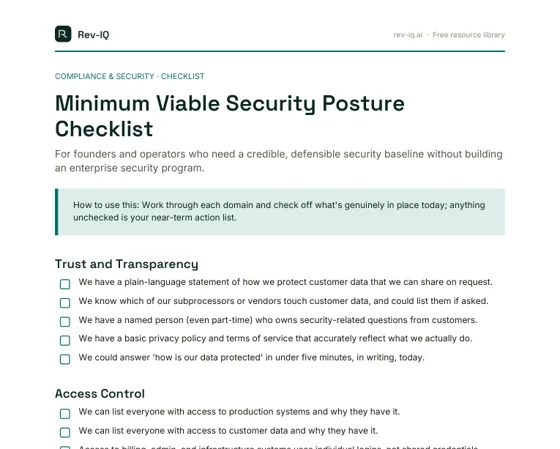
- Trust and Transparency
- Access Control
- Device and Endpoint Basics
- AI and Automation
- Documentation and Response
- If Your Product Is AI-Built
- When a Certification Becomes Worth It
- Baseline Status Summary and Standards Map
- Format
- PDF, 4 pages, designed to print and fill in
- Best for
- Founders and operators of small technology companies
- What to bring
- Current access lists, device details, the AI tools in use, existing security documents, and customer-facing security information
- After you submit
- Your download starts straight away. Nothing is emailed to you, and you won't be added to a mailing list unless you tick the opt-in.
Templates get you moving fast. If you want a structured read on where this is actually breaking down in your business, that's a short diagnostic conversation, not another download.
Discuss advisory support →