Where Late-Stage Deals Go to Die
The deal looks done. The buyer has said yes, verbally, the champion is keen and the close date is in the forecast for the end of the month. Then the gaps appear. Procurement needs you set up as a supplier. Security sends a two-hundred-question questionnaire. Legal wants changes to the liability clause. A new executive asks to "just take a quick look". The signatory is on leave. The month ends, the deal moves to next month, and then the one after.
None of these steps were secret. They exist in almost every organisation that buys B2B technology. They become a problem because nobody wrote them down at the start, agreed who owned each one, or worked backward from the date the buyer actually needed to be live. The seller was forecasting a signature. The buyer was working through a process the seller had never seen.
The second way late-stage deals go wrong is in negotiation. Under pressure to hit a number, the first move is often a discount, offered before the buyer has even asked for one, in exchange for nothing. It feels like it speeds things up. In practice it usually teaches the buyer that the price was never real, invites a second round of asking, and sets the starting point for every renewal that follows.
A mutual action plan addresses the first problem. Disciplined, prepared negotiation addresses the second. They work best together, because a buyer who has committed to a shared plan is negotiating toward an outcome they want, not just against your price.
What a Mutual Action Plan Is, and Isn't
A mutual action plan is a short, shared document that lists every step both organisations need to take between now and the buyer being live and getting value, with an owner and a date for each. It is written with the buyer, not for them, and both sides can see and update it.
It is not your internal close plan, and it is not a pressure tactic. If it reads as a list of things the buyer must do so you can hit your quarter, they'll treat it that way and quietly ignore it. The plan works when it is anchored to something the buyer cares about: a go-live date before their busy season, a new site opening, a contract starting, a regulatory deadline or a board meeting where results need to be shown.
Start from that date and work backward. If the buyer needs to be live by 1 March and implementation takes eight weeks, the work has to start in early January. In Australia, that likely means signature before the Christmas shutdown, which means legal and procurement need to be finished in early December. Laid out that way, the timeline is the buyer's own logic, not your sales calendar.
Building One With the Buyer
Introduce a mutual action plan once the buyer has agreed there's a problem worth solving and your approach is a credible way to solve it, usually after discovery and a solution conversation, before the proposal. A simple question opens it up: "If you wanted to be live by March, what would need to happen on your side between now and then?"
Draft the first version yourself, based on what you've heard and what you know typically happens, then send it to the champion and ask them to correct it. Their edits are the most valuable part. They'll add steps you didn't know about, change dates you got wrong and name people you haven't met. A plan the buyer has edited is a plan they've committed to.
| Step | Owner | Target date |
|---|---|---|
| Confirm requirements and success measures | Buyer: operations manager. Seller: account executive | 24 October |
| Business case reviewed with finance | Buyer: operations manager | 7 November |
| Security questionnaire returned with evidence | Seller: account executive and security lead | 7 November |
| Proposal and contract issued | Seller: account executive | 10 November |
| Supplier onboarding forms and insurance certificates | Buyer: procurement. Seller: finance | 14 November |
| Legal review and agreed changes | Buyer: legal counsel. Seller: commercial lead | 28 November |
| Approval and signature | Buyer: general manager | 5 December |
| Implementation kick-off | Both: project leads | 12 January |
| Go-live | Both | 1 March |
Keep the plan short enough to read in two minutes. A dozen steps is plenty. Review it on every call with the champion, update it when dates change and keep it somewhere both sides can see. A shared document or a simple page in a deal room works better than an attachment that gets lost in an inbox.
The Steps Everyone Forgets
Most slippage comes from steps the seller didn't know existed. Ask about each of these explicitly early in the deal, rather than discovering them in the final week:
- Supplier onboarding. New vendor forms, bank detail verification, insurance certificates and sometimes a separate risk assessment, all before a purchase order can be raised.
- Security and privacy review. Questionnaires, evidence requests, a privacy impact assessment or a data processing agreement. These can take weeks if you're not prepared. The guide to handling customer security questionnaires covers how to shorten them.
- Legal review. Who reviews contracts, how long their queue is, and which clauses they always push on.
- Approval thresholds. The value above which a CFO, CEO or board must approve, and when those approvals happen.
- Signing authority. Who can actually sign, and whether they'll be available.
- Budget timing. Whether money is allocated this financial year or needs to wait for the next.
- Holidays and shutdowns. Christmas through January, school holidays and end of financial year all affect availability in Australian organisations.
Each of these belongs in the plan with an owner and a date. If the buyer doesn't know the answer, that is useful information too, and asking the question often prompts the champion to find out.
A Plan Needs More Than Your Champion
A mutual action plan with a single name on the buyer side is fragile. If that person goes on leave, changes role or loses an internal argument, the deal stops. Most B2B purchases involve several people with different concerns: the person who signs, the champion who feels the problem, the people who'll use the product, someone who evaluates technical fit, plus procurement and legal.
Use the plan to build relationships with each of them. Every step owned by someone other than your champion is a reason to meet that person, understand what they need and make it easy for them. By the time the contract reaches signature, you should have spoken directly to the signatory, or at least know exactly how your champion will present it to them and what they're likely to ask.
Using the Plan to Forecast Honestly
A mutual action plan is the most reliable forecasting evidence a late-stage deal can have. A deal where the buyer has edited the plan and is completing their steps on time is very different from a deal where the only evidence is a verbal yes and a hopeful close date.
Watch the buyer-owned steps in particular. When they start slipping, the deal is slipping, regardless of how positive the champion sounds. Raise it early and directly: "We'd planned for the business case to go to finance last week. Has something changed?" Then update the close date in your CRM to reflect what's actually happening. Moving a date early is far better than carrying a deal you know is late, and it keeps the pipeline and forecast honest.
Why Discounting First Is So Expensive
A discount comes straight off the top line, and for most technology businesses the cost of delivering the product doesn't fall with it, so almost every dollar of discount is a dollar of margin. It also tends to outlive the deal. A 10% discount on an A$100,000 annual contract is A$10,000 in the first year, and if renewals are anchored to the discounted price, it is A$30,000 over three years, before any price increases are applied to the lower base.
The less visible costs are often bigger. An unprompted discount signals that the original price wasn't a serious number, which invites the buyer to ask for more. It teaches buyers to wait for the end of your quarter. And it undermines the value conversation you've spent the whole deal building: if the solution is worth what the business case says, why would you need to cut the price to get it signed?
None of this means you should never discount. It means a discount should be a deliberate trade, prepared in advance, not a reflex under pressure.
Prepare Before You Negotiate
Most negotiation problems are preparation problems. Before any commercial conversation, work out four things:
- Your target outcome. The price, term and scope you're aiming for and can justify with the business case.
- Your walk-away point. The terms below which you'd rather not do the deal, and why. Decide this before the conversation, not during it.
- The buyer's alternatives. What they'll realistically do if they don't buy from you: a competitor, building it themselves, or carrying on as they are. Your leverage depends on how attractive those alternatives are.
- Your approval limits. What you can agree to on the spot, what needs a manager and what needs the CEO. Clear discount guardrails stop individual reps from making pricing decisions the business would never have approved.
Then build a list of tradeables: things you can give and things you can ask for in return. The best tradeables cost you little but are worth a lot to the buyer, or the reverse.
| You could give | You could ask for in return |
|---|---|
| A price reduction | A longer contract term, or payment annually in advance |
| Additional implementation or training support | Signature by an agreed date that suits both sides |
| Extra users or modules | A broader rollout commitment, or a higher minimum volume |
| Price protection on renewal | A multi-year commitment |
| Flexible payment terms | A case study, reference call or testimonial once live |
Give and Get: Never Concede Without a Trade
The single most useful negotiating habit is simple: every concession is matched by something in return. When a buyer asks for a lower price, the answer is not yes or no, it is a question. "We could look at that. If we moved on price, could you commit to a two-year term?" That reframes the conversation from whether you'll cut your price to what each side is willing to exchange.
A few other principles help:
- Concede slowly and in decreasing steps. Large, fast concessions signal there's plenty more room. Smaller, slower ones signal you're approaching a real limit.
- Don't negotiate against yourself. If you've made an offer, wait for a response before improving it. Silence is uncomfortable, but it is not a rejection.
- Trade on the whole package, not line by line. Agreeing each point in isolation leaves you with nothing to trade at the end. Keep open items linked until the overall deal is agreed.
- Keep a concession log. Write down what was asked for, what you offered, what you got in return and who approved it. It stops promises getting lost and makes the final contract easier to check.
Working With Procurement
Procurement teams are paid to get a better deal, and asking for a discount is often a standard step in their process, regardless of how good the price already is. Don't take it personally and don't treat them as an obstacle. Treat them as another stakeholder with a legitimate job to do.
Prepare a reasoned response rather than a number. Refer back to the business case and the value the buyer's own team has agreed. Offer options rather than a single discount: different terms, payment structures or scope. If you're asked for your "best and final" offer, be sure it genuinely is, because if you improve it afterwards, nothing you say about price will be believed again.
Above all, make sure procurement isn't seeing the deal for the first time at the end. Bringing them into the mutual action plan early, with supplier onboarding and their review steps scheduled, turns them from a late surprise into a planned part of the process.
End-of-Quarter Pressure Is Your Problem, Not Theirs
Discounts tied to your own deadlines are the hardest habit to break and the most damaging. A buyer who learns that prices drop in the last week of each quarter will simply wait for the last week of each quarter. Sophisticated buyers already know this.
If you want a deal signed by a certain date, connect the date to something the buyer values: starting implementation before their busy period, locking in an implementation slot, or going live in time for a deadline in the mutual action plan. If you do offer a time-bound commercial incentive, make it a genuine trade, approved in advance, and be prepared for it to expire if the date passes. An incentive that's quietly extended teaches the buyer that your deadlines aren't real either.
Putting It Into Practice
Use the Mutual Action Plan and Negotiation Planner for your next late-stage deal. The first part helps you draft a dated plan with the buyer, including the procurement, security and legal steps that usually cause slippage. The second part prepares the negotiation: target and walk-away, the buyer's alternatives, approval limits, a tradeables list and a concession log.
Start the plan earlier than feels natural. The best time to introduce it is when the buyer is enthusiastic and the deal feels like it's going well, because that is exactly when they're most willing to map out what it will really take to get done.
- Anchor the mutual action plan to a date the buyer cares about, then work backward, allowing for shutdowns and approval cycles.
- Draft the plan yourself, then have the champion edit it. A plan the buyer has corrected is a plan they've committed to.
- Ask early about supplier onboarding, security review, legal, approval thresholds, signing authority and budget timing.
- Watch buyer-owned steps: when they slip, the deal is slipping, so move the close date early and keep the forecast honest.
- Prepare your target, walk-away, the buyer's alternatives and your approval limits before any commercial conversation.
- Never concede without a trade, concede slowly, and keep a concession log so nothing promised gets lost.
Frequently asked questions
What is a mutual action plan in B2B sales?
A short, shared document listing every step both organisations need to complete between now and the buyer being live, each with an owner and a date. It's built with the buyer and anchored to a date that matters to them.
When should you introduce a mutual action plan?
Once the buyer agrees there's a problem worth solving and your approach is credible, usually after discovery and before the proposal. That's when they're most willing to map what it will take to get done.
How do you respond when a buyer asks for a discount?
With a question about what they could give in return, such as a longer term, annual payment in advance or signature by an agreed date. Every concession should be a trade, prepared in advance and within approved limits.
Why are end-of-quarter discounts a problem?
They teach buyers to wait for your deadline, cost margin that often carries into renewals, and undermine the value case. Tie urgency to the buyer's own dates instead.
Mutual Action Plan and Negotiation Planner
For account executives and sales leaders planning the path to signature with the buyer and preparing negotiations that protect margin.
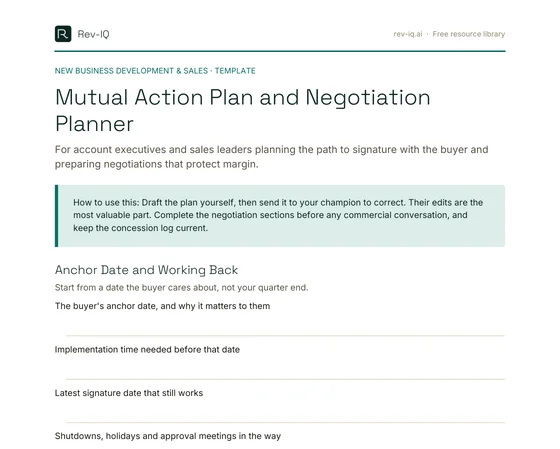
- Anchor Date and Working Back
- Mutual Action Plan
- Hidden Steps Check
- Stakeholder Coverage
- Negotiation Preparation
- Tradeables
- Concession Log
- Format
- PDF, 4 pages, designed to print and fill in
- Best for
- Account executives and sales leaders whose late-stage deals slip or close at a heavy discount
- What to bring
- The buyer's target go-live date, what you know about their approval process, and your pricing and discount guardrails
- After you submit
- Your download starts straight away. Nothing is emailed to you, and you won't be added to a mailing list unless you tick the opt-in.
Rev-IQ New Business BDM Kit
Six AI skills for Claude, ChatGPT and Perplexity that apply this framework: draft a dated mutual action plan that works back from go-live, cost every discount over the full term, and prepare tradeables and walk-away points before the negotiation. They run in your own AI account.
See the New Business BDM Kit →Templates get you moving fast. If you want a structured read on where this is actually breaking down in your business, that's a short diagnostic conversation, not another download.
Discuss advisory support →