Why Good Deals Die in Finance
A familiar pattern in B2B sales: the demos went well, the users want it, your champion is genuinely enthusiastic, and the deal reaches the final stage. Then it stops. The champion says it's "with finance" or "waiting on budget". A few weeks later the close date moves, then moves again, and eventually the deal is marked lost to "no decision".
The product didn't fail. The business case did, or there wasn't one. The champion was convinced by what they saw, but the person who approves the spend wasn't in those meetings. What reached them was a quote, a few slides of features and a sentence about efficiency. Compared with every other request competing for the same money, including the option of doing nothing at all, that isn't enough.
A business case is how the value you've uncovered in discovery survives the trip into a room you're not in. It translates the problem into money, shows what the investment really costs, and lets a sceptical finance leader check the logic for themselves. Done well, it is short, conservative and built from the buyer's own numbers.
Whose Business Case Is It?
The most common mistake is treating the business case as a vendor document: an ROI calculator full of your assumptions, your benchmark figures and your best-case outcomes. Finance teams have seen hundreds of these, and they discount them heavily, often to zero.
A business case that gets approved belongs to the buyer. Your job is to help the champion build it, supply the structure, contribute what you know about implementation and typical results, and pressure-test the numbers. Their job is to provide the baseline figures, own the assumptions and present it internally. When the CFO asks where a number came from, the answer should be "our operations data" or "our finance team's estimate", not "the vendor told us".
This also changes the conversation earlier in the deal. If you know a business case will be needed, ask for the inputs during discovery rather than scrambling for them at the end. "If this goes ahead, how will your finance team want to see the return?" is a perfectly reasonable question in a second meeting, and the answer tells you a great deal about how the decision will actually be made.
Start With the Baseline, in Their Numbers
Every credible business case starts with what the problem costs today. That baseline comes from discovery: how often the problem occurs, how long it takes to deal with, how many people are involved, what goes wrong as a result, and what that costs in time, money, risk or revenue.
Ask for the buyer's own figures wherever they exist. Volumes, headcount, hours, error rates, penalties paid, revenue lost to churn or delays. Where they don't have precise data, estimate together and label the number clearly as an estimate, with the reasoning beside it. "Coordinators estimate around eight hours a week each on rework" is honest and checkable. A precise-looking figure with no source is neither.
For staff time, use a loaded hourly cost that includes salary, superannuation and on-costs, and agree the figure with the buyer, ideally with someone in finance. It is one of the numbers CFOs most often question, and a rate they've signed off themselves removes the argument.
The Four Places Value Comes From
Almost every benefit in a B2B business case falls into one of four categories. Finance teams treat them very differently, so it helps to be explicit about which is which.
| Value type | Examples | How finance tends to see it |
|---|---|---|
| Revenue growth | Faster sales cycles, higher conversion, reduced churn, new revenue streams | Valuable but uncertain; expect a hard look at attribution |
| Cost reduction | Fewer licences, lower contractor spend, avoided hires, reduced penalties or rework | The most credible, especially when it shows up in the budget |
| Risk reduction | Fewer compliance breaches, lower likelihood of outages or data incidents | Real but hard to quantify; best shown as likelihood multiplied by impact |
| Capacity and time | Hours freed for higher-value work, faster turnaround | Often discounted unless the time is redeployed or avoids a planned cost |
The last category deserves care. "We'll save 2,000 hours a year" sounds impressive, but a CFO will immediately ask whether anyone's salary goes down. If it doesn't, the saving isn't cash. Capacity becomes hard value when it avoids a hire the business was planning to make, reduces overtime or contractor spend, or lets the same team handle growth they otherwise couldn't. Make that link explicitly, or present capacity as a secondary benefit rather than the headline.
Count the Full Cost, Not Just Your Price
A business case that only shows your subscription fee is incomplete, and finance will notice. The full cost of an investment usually includes:
- Licence or subscription fees, for the full contract term.
- Implementation, configuration and integration fees, from you or a partner.
- Internal staff time for the project, training and change management.
- Any additional infrastructure, tools or data work required.
- Switching costs, such as running old and new systems in parallel for a period.
Include offsets too. If the new solution replaces an existing tool, the licence you'll cancel is a real saving. Showing the full cost, including the internal effort, does something counterintuitive: it makes the case more credible. A finance leader who sees that you've accounted for the costs they would have raised themselves is far more likely to trust the benefits.
The Maths: Payback, Return and Staying Conservative
Most finance teams want two numbers: how long until the investment pays for itself, and what it returns over a reasonable period. Keep the maths simple enough that someone can check it on a calculator.
- Payback period is the one-off cost divided by the monthly net benefit (the monthly benefit minus ongoing costs). It answers "how quickly do we get our money back?"
- Net return over three years is total benefits minus total costs over the period. Return on investment is that net return divided by total costs.
Always show at least two scenarios: a conservative case that you'd be comfortable being held to, and an expected case based on reasonable assumptions. A single optimistic number invites the CFO to cut it in half, and once they've done that they'll distrust everything else on the page. Conservative assumptions you've cut yourself are far more persuasive.
Here is a simple worked example. It is illustrative only, with invented figures.
Worked example
A logistics business has six coordinators, each spending about eight hours a week on manual scheduling rework. At a loaded cost of A$50 an hour over 45 working weeks, that is 2,160 hours and A$108,000 a year. The business also paid A$40,000 in late-delivery penalties last year, which it attributes mostly to scheduling errors. The proposed solution costs A$30,000 a year, plus A$12,000 for implementation and about 100 hours of internal project time (A$5,000), so A$17,000 in one-off costs.
| Conservative | Expected | |
|---|---|---|
| Rework time recovered | 40%: A$43,200 | 70%: A$75,600 |
| Reduction in late-delivery penalties | 25%: A$10,000 | 50%: A$20,000 |
| Annual benefit | A$53,200 | A$95,600 |
| Annual subscription | A$30,000 | A$30,000 |
| Net annual benefit | A$23,200 | A$65,600 |
| One-off costs | A$17,000 | A$17,000 |
| Payback from go-live | About 9 months | About 3 months |
| Three-year net return | A$52,600 | A$179,800 |
Notice what the example does. The time saving only counts if it becomes real money, so the case should say how: perhaps the business was planning to hire a seventh coordinator for a new site, and the recovered time means it doesn't need to. The penalty reduction is based on what the business actually paid. Both scenarios are shown, and even the conservative one pays back within the first year. That is a case a finance leader can test and approve.
Two more refinements make a case more robust. First, allow for ramp-up: benefits rarely arrive in full on go-live day, so in your own case assume a period of partial benefit while the team adopts the new way of working. Second, show sensitivity: what happens to payback if the main assumption is half what you expect? If the investment still makes sense, say so. If it doesn't, you've learned something important before the CFO does.
The Cost of Doing Nothing
Your real competitor in most deals is the status quo. A business case should make the cost of staying put as visible as the cost of acting. If the problem costs A$148,000 a year today and is likely to grow with volume, a twelve-month delay is not neutral. It is a decision to spend that money again.
Be careful with this. Inflating the cost of inaction, or leaning on fear, damages credibility as fast as inflating the benefits. Use the same baseline, the same assumptions and the same honesty. Where the problem is getting worse, show why with the buyer's own evidence: volumes growing, a new site opening, a contract with stricter service levels, or a regulatory deadline approaching.
One Page, Structured How Finance Reads
A business case doesn't need to be long. It needs to answer the questions a decision-maker asks, in the order they ask them. One page is usually enough, with supporting detail available if requested:
- The problem. What's happening, what it costs today and why it matters now.
- The recommendation. What you propose to do, in one or two sentences.
- The investment. Total cost over the term, split into one-off and ongoing.
- The return. Conservative and expected benefits, payback and three-year net return.
- Risks and mitigations. What could stop the benefits arriving, and what's in place to prevent it.
- How success will be measured. Two or three metrics, a baseline and a review date.
- The decision required. What approval is needed, from whom, and by when.
Write it in the buyer's language, using their terms for their processes, their metrics and their internal project names. A business case that reads like their own internal paper is far easier for a champion to present than one that reads like your marketing material.
What the CFO Will Ask
Prepare your champion for the questions before they're asked. Most finance reviews come back to the same handful:
- Where does each number come from, and who agreed it?
- What happens if the benefit is half what you expect?
- Is the saving real cash, or freed time that won't change the budget?
- When does the money go out, and when do the benefits come in?
- Who owns delivering the benefit, and how will we know if it's working?
- What's the contract term, and what are our options if it doesn't work?
- What else could we do with this money, including doing nothing?
If the one-page case already answers these, the review becomes a confirmation rather than an interrogation. Where you can, offer to join a short session with the finance lead to walk through the assumptions. Many champions welcome the support, and it means questions get answered directly rather than relayed.
Know How Money Gets Approved Before You Need It
A business case can be perfect and still stall if it arrives at the wrong point in the buyer's budget cycle or goes to the wrong approver. Early in the deal, ask how investments like this are usually approved. Is there a spending threshold above which the CFO, the CEO or a board needs to sign off? Is budget already allocated, or does this need to compete in the next planning round? Are there approval meetings with fixed dates?
Those answers belong in your deal plan and, ideally, in a mutual action plan agreed with the buyer. A business case that's ready the week before the investment committee meets is in a very different position to one that arrives the week after.
Putting It Into Practice
Use the Business Case Builder Worksheet to work through the case with your champion: the baseline, the value drivers, the full cost, the conservative and expected scenarios, payback, the cost of inaction and the one-page summary. It is designed to be filled in together, not by you alone, so that the numbers belong to the buyer from the start.
The habit worth building is to start the business case during discovery rather than at the end. Every baseline number you gather early is one less thing to chase when the deal is on the line.
- Deals lost to no decision often lack a business case the approver can test, not a better product.
- Build the case with your champion, from the buyer's own numbers, so they can defend it in rooms you're not in.
- Separate cost reduction, revenue, risk and capacity, and only count freed time as cash when it avoids a real cost.
- Show the full cost, including implementation and internal time. It makes the benefits more credible, not less.
- Present conservative and expected scenarios with payback and three-year return, and test what happens if the main assumption halves.
- Find out early how investments are approved, by whom and when, so the case arrives at the right moment.
Frequently asked questions
What should a B2B business case include?
The problem and what it costs today, the recommendation, the full investment, conservative and expected returns with payback, risks and mitigations, how success will be measured, and the decision required from whom and by when. One page is usually enough.
How do you calculate payback period for a software investment?
Divide the one-off costs by the monthly net benefit, which is the monthly benefit minus ongoing costs such as the subscription. Show it for both a conservative and an expected scenario.
Why do CFOs discount time savings?
Because freed time doesn't reduce costs unless it's redeployed or avoids a planned expense. Link time savings to an avoided hire, reduced overtime or contractor spend, or growth handled without extra headcount.
Should the vendor or the buyer build the business case?
The buyer should own it, with the vendor supplying structure and pressure-testing the numbers. A case built from the buyer's own figures is far more credible than a vendor ROI calculator.
Business Case Builder Worksheet
For account executives and founders building a business case with their champion that a sceptical finance leader can check and approve.
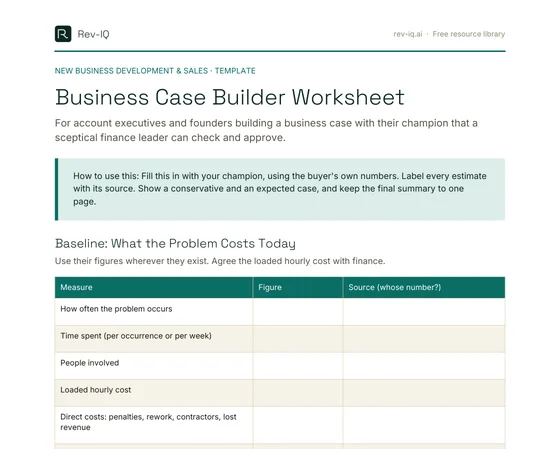
- Baseline: What the Problem Costs Today
- Value Drivers
- Full Cost of the Investment
- Scenarios, Payback and Return
- Cost of Doing Nothing
- One-Page Summary
- CFO Question Check
- Approval Path
- Format
- PDF, 5 pages, designed to print and fill in
- Best for
- Account executives and founders whose deals stall at budget or finance approval
- What to bring
- Your discovery notes, the buyer's own figures for volumes, time and cost, and your proposed pricing
- After you submit
- Your download starts straight away. Nothing is emailed to you, and you won't be added to a mailing list unless you tick the opt-in.
Rev-IQ New Business BDM Kit
Six AI skills for Claude, ChatGPT and Perplexity that apply this framework: build a one-page business case from the buyer's own numbers, with conservative and expected payback, a sensitivity test and the CFO's likely questions. They run in your own AI account.
See the New Business BDM Kit →Templates get you moving fast. If you want a structured read on where this is actually breaking down in your business, that's a short diagnostic conversation, not another download.
Discuss advisory support →